Baptism is the sacrament through which we are freed from sin, become children of God and members of Christ and his Church, and share in the Church’s mission.
Holy Baptism is the basis of the whole Christian life, the gateway to life in the Spirit (vitae spiritualis ianua), and the door which gives access to the other sacraments. Through Baptism we are freed from sin and reborn as sons of God; we become members of Christ, are incorporated into the Church and made sharers in her mission: “Baptism is the sacrament of regeneration through water in the word.”
CCC 1213
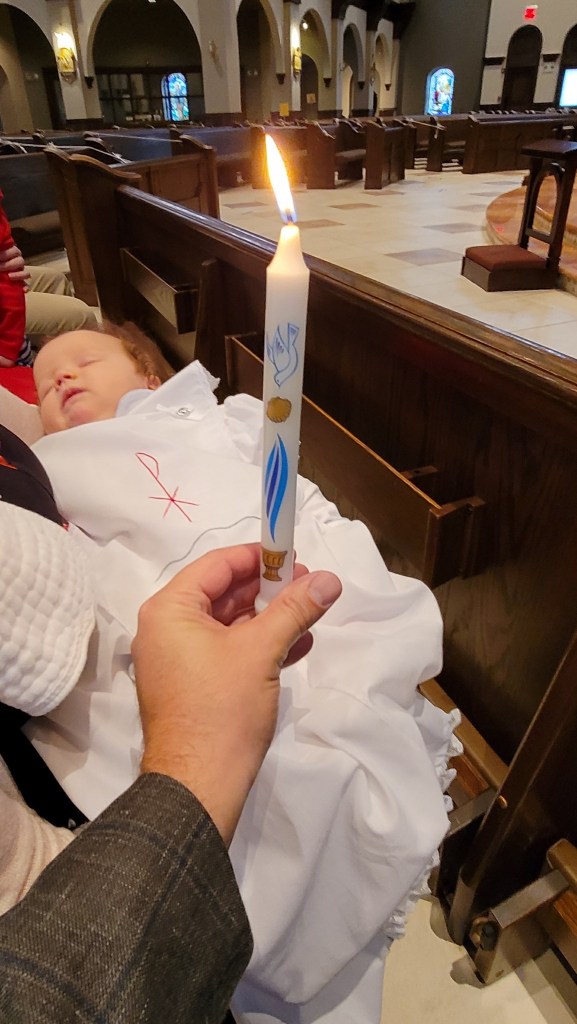
Baptism is one of the three sacraments of initiation. This is the first sacrament we receive and it often is done during infancy. People who believe in Jesus and want to be his followers are baptized. Christians later in life will receive this sacrament in their journey of being Christian. In the Catholic Church these people will go through a liturgical experience called the Rite of Christian Initiation of Adults, RCIA. For children it is called RCIC: Rite of Christian Initiation of Children and this is for children under the age of 18. During the Easter Vigil these people, called CATECHUMENS, will receive all three sacraments of initiation: Baptism, Confirmation, and Holy Eucharist.
Truly, truly, I say to you, unless one is born of water and Spirit, he cannot enter the Kingdom of God
John 3:5
Read Mark 1: 9-11 The Baptism of the Lord. Look at some art depicting the Baptism of Our Lord: From Giotto to Rubens: The Baptism of the Lord in Painting
Jesus’ baptism in the Jordan Rive by John the Baptist marked the beginning of Jesus’ public ministry. Baptism comes from the Greek word baptizein for “plunging” or “immersing”. Bishops, priests, and deacons are the ministers of Baptism.* A person may only receive this sacrament once and it removes all sins original and actual. Baptism is the beginning of a Christian life. People are baptized at church using a Baptismal Font and Holy Oils. A Baptismal Font is a large vessel used to hold the baptismal water during administration of the sacrament. Baptismal fonts are customarily found next to the altar but some modernly designed churches may have a more unique location of the baptismal font. For some good pictures of different styles of baptismal fonts see Baptismal Font Facts for Kids. (Disclaimer: there are many examples of Catholic and other Christian church fonts on this page.)
An Ambry is a special cupboard in the sanctuary of the Church where all of the Holy Oils are kept for administering the sacraments. These Holy Oils: Holy Chrism, Oil of Catechumens, and Oil of the Sick are blessed by the Bishop at the Chrism Mass usually held on Holy Thursday. These oils are then distributed to all the parishes within the Diocese to use for the year. See: A Closer Look at the Holy Oils.
Watch: What’s Inside A Catholic Church EPISODE 1 In this first episode “The Baptistry”, “The Paschal Candle”, “The Ambry”. The Cathedral of St. John the Evangelist in Milwaukee, WI.
We are all born without sanctifying grace, the lasting presence of God in us that makes us holy, and we need to be baptized to remove the original sin brought upon us by Adam and Eve. Baptism is the beginning of our relationship with Christ. Catholic parents are called to baptize their babies shorty after birth so that their children can have grace as soon as possible. At baptism we regain sanctifying grace and are spiritually marked as belonging to Christ. We receive the virtues of faith, hope, and charity as well as the gifts of the Holy Spirit to help us grow in holiness.
Symbols of Baptism
White (wearing white)
Candle
Oil (holy chrism & oil of catechumens)
Water
Purity
Jesus the light of the World
Called to be Prophets, Priests, Kings: strength of life
Life and Death
When a baby is brought to Church for their baptism the Celebrant will take the Oil of Catechumens and anoint the baby and the words of exorcism will be said to drive out any evil. The parents and Godparents will make the baptismal promises for the baby and then the sacrament of baptism by water begins. The celebrant using consecrated water will pour it over the baby’s head three times while saying the words “I baptize you in the name of the Father and the Son and the Holy Spirit” . Then the Celebrant will anoint the baby with the Holy Chrism oil. The baby’s baptismal candle is lit from the Paschal candle to symbolize that he or she is now enlightened by Christ to bring light to the world.
*** Read Lesson 24: Baptism in the St. Joseph Baltimore Catechism Book #2 ****
Assignment:
When was Jesus baptized? Can you remember the scripture where this story is told?
What is your baptism story? Ask your family to tell you about when were you baptized. Do you know the date? How old were you? Who are your Godparents? Can you find any pictures from that day? Did your family celebrate? Does your family celebrate your baptism day every year?
Tape a picture of your baptism day into the notebook. If you cannot find one draw your own picture.
* In emergencies anyone can baptism a person by saying the words “I baptize you in the name of the Father and the Son and the Holy Spirit” while pouring water over the person’s head. For more about emergency baptism read: How laypeople can baptize in an emergency
Sources:
Catechism of the Catholic Church : Article 1 Baptism
Style and Location of Baptismal Fonts Archdiocese of Newark, NJ
The Sacred Depth of the Baptismal Font: The Place of Re-Creation by Denis R. Mcnamara
Storage of the Holy Oils by EWTN
Totally Catholic A Catechism for kids and their parents and teachers By Mary Kathleen Glavich, SND
What are the Three Holy Oils (added 2.23.24)
***** FFF week 7 sacramental learning week October 10, 2023 *******
 The Small Pencil Catechist