Our Lady of the Cape Miracle of the Ice Bridge
Our parish held a festival celebrating the feast of Our Lady of the Rosary on October 7th from 12:00 to 4:00PM. The event was for families with children of all ages. It was a wonderful event for all ages. There were multiple activities going on simultaneously allowing people to choose the ones that appealed to them most.
Outside there were activities typical of a festival with food and drink available to buy. There were some games for children to do and a few contests. Some Guatemalan sawdust artists were making images of Mary on the concrete at the entrance of the church. At the end of the festival there was a Marian procession. In one classroom the children were able to make a paper rose to be brought to the statue for the procession. Inside the main church an International Rosary was prayed where the rosary was spoken in multiple languages. Afterward Father gave a talk about Our Lady of Loreto. The children were encouraged to attend a puppet show while the parents took advantage of Father’s lecture. In our Hall children were able to decorate cupcakes with roses. That was a big hit!
In the classrooms there were various themed rooms with unique activities and or experiences. There was a preschool room where the younger children could spend time working on multiple activities tailored to ages 3-6. One room was devoted to learning about Mary’s wardrobe and was more lecture based with opportunities for the children to handle materials. Another room was dedicated to the Rosary. There you could make a some sacrifice beads or have your broken/damaged rosaries repaired. The remaining five classrooms were devoted to a lesser known Marian image/apparition as the focus for the activity. This is where I was assigned to volunteer. My apparition was: Our Lady of the Cape in Trois-Rivières, Quebec. The other rooms were: Our Lady of Aparecida in Brazil, Our Lady of Siluva in Lithuania, Our Lady of Guidance in Philippines, Our Lady of Kibeho in Rwanda.
Each room leader was given the freedom to come up with an activity for their location. Initially this festival was imagined to be an around the world with Mary like experience. I was unfamiliar with my assigned room and needed to learn all about this fascinating apparition. Once I learned all about it I was struggling to decide on an activity. I had plenty of ideas but trying to come up with something that would be fun to do yet open to all to do was very challenging. With the around the world experience our rooms were to be set up as a drop in type of event where people would wander in and participate at will. Unlike past events where we would have set timing and rotations between rooms the open door flow could really be hard for some types of activities and especially some of the art based ideas I was imagining.
A little prayer and some sleep can do wonders for you and idea making. It is how we here at the Small Pencil Catechist tend to do our best work: prayer and rest. This is how I came to the idea of making this apparition a STEM based activity. Before I describe what I ended up doing for the room I’ll tell you a little about the Our Lady of Cape and the Miracle of the Ice Bridge. Our Lady of the Cape Shrine founded in 1888 is the third largest Marian Shrine in North America. Located in the district of Cap-de-la-Madeleine along the St. Lawrence River the Shrine attracts thousands of pilgrims from around the world. The historic Old Shrine inaugurated in 1720 is the oldest church in Canada. In 2020, the Shrine celebrated its 300th anniversary! Two Marian Miracles: The Miracle of the Ice Bridge in 1879 and The Prodigy of the Eyes in 1888 have drawn a significant Marian devotion.
The Miracle of the Ice Bridge in 1879 was the inspiration for my STEM challenge. By the 1870s the parish had seen an increase in its Catholic population and the need for a new church was being planned. The plan was to demolish the current church its stones saved to be used to build the larger church. The additional stone would have to be brought across the St. Lawrence River from the quarry. The year the construction began had an unseasonably warm winter. They would need to haul the stone across the frozen river during the winter to ready the materials for building in the spring. By March 1879 the river remained unfrozen leaving the parishioners wondering how to transport all the stone across the river. Father Luc Désilets knew he could only hope and pray. One night in March burdened with worry he began praying asking the Blessed Virgin Mary to intercede and help the river freeze. He prayed with a promise. He vowed not to destroy their original church and to dedicate it to Mary. In mid-March the weather cooled and an ice jam began to form between the narrow part of the river. The parishioners seeing this hurried to bring snow to help the ice to solidify making an ice bridge strong enough for horse-drawn sleds to cross the river. Over the next days, the local people recited the rosary continually. Despite the fragile layer of ice that deteriorated quickly as loads of stone were carried across, the bridge held — a miracle attributed to the praying of many rosaries. The ice stayed in place from the feast of St. Joseph, March 19, to the Solemnity of the Annunciation, March 25. Just after the last load had been safely brought across, the ice bridge collapsed. The ice bridge, considered by many to be a miracle brought about by prayers and recitation of the rosary, was called the “Rosary Bridge”. To this day descendants of the men who risked their lives hauling stone across the “Rosary Bridge” round the clock keep the memory of this miracle alive by sharing those stories. What an amazing miracle! I particularly love that the bridge formed on the feast of St. Joseph. Mary being such the intercessor we know her to be and a bridge forming on the the feast of St. Joseph and Joseph known for his being a craftsman……that they being united together in holy marriage how these things came together is so extraordinary.
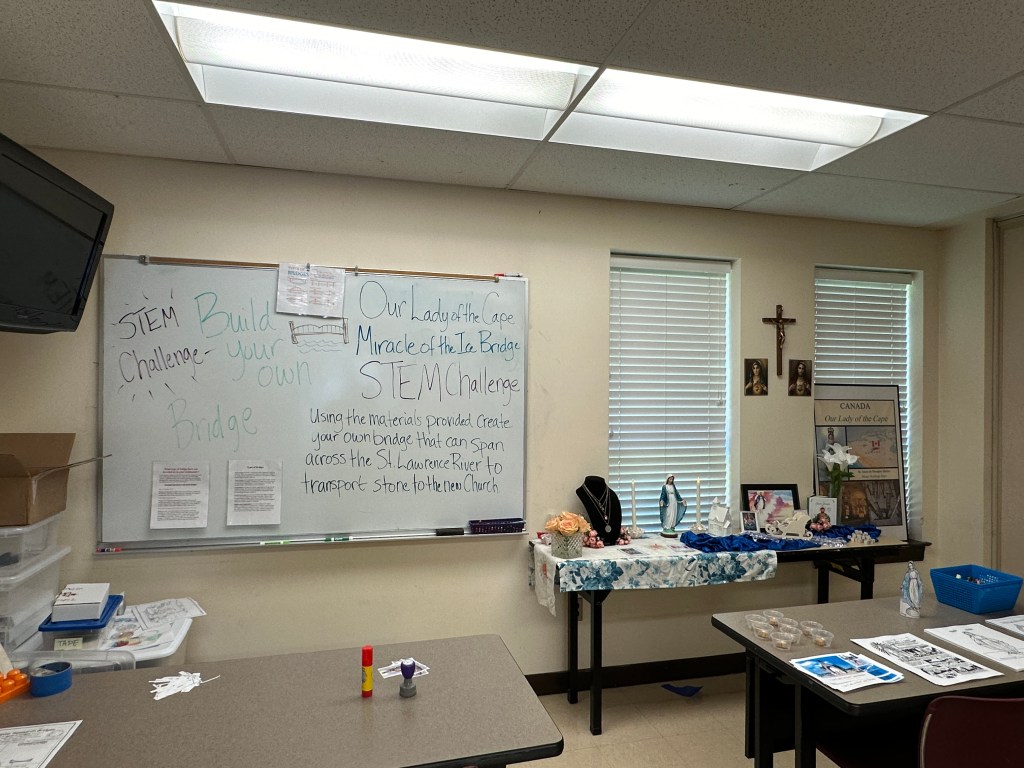
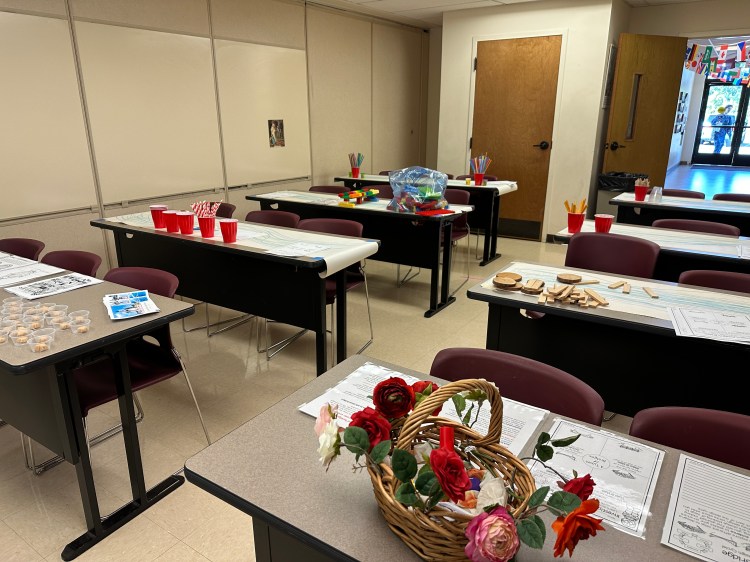
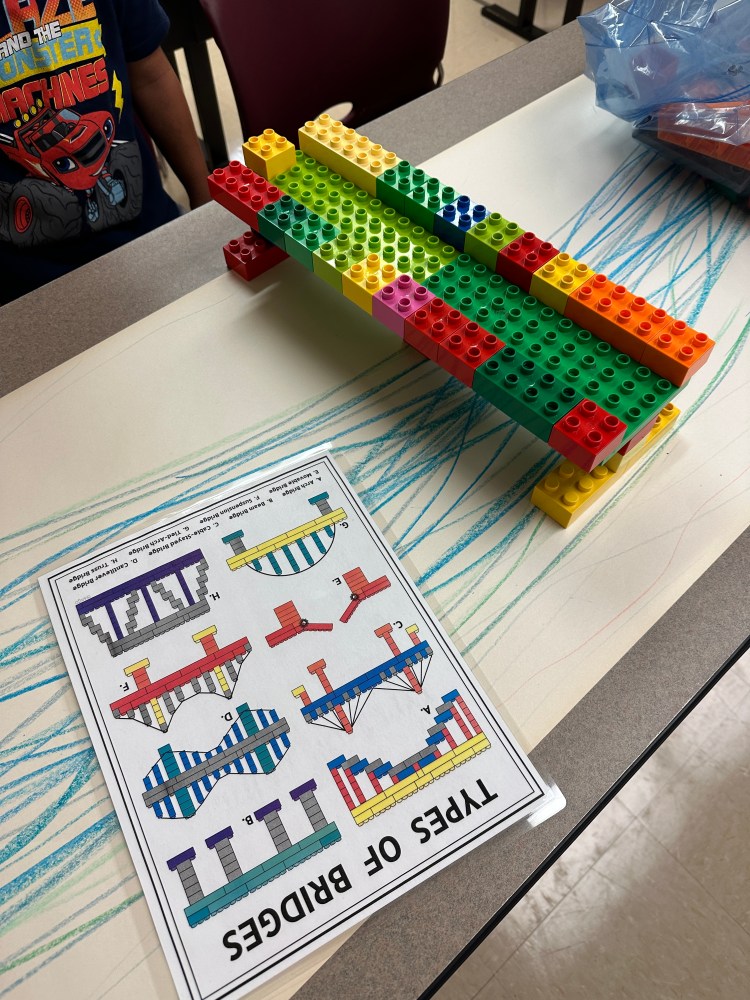
For the STEM challenge I created several stations where I placed different materials for use to create bridges across the river. I taped craft paper to the table and drew river shapes on to the paper with crayons. I provided some guideline packets for each table with examples of how to build bridges with the materials. The stations were: Legos, straws and playdough, cups and popsicle sticks, pencils and rubber bands, Kapla blocks and wood rounds, and loose parts. Loose parts were just an assortment of office supplies and random items I collected that would be interesting to use. I had tape, paperclips, binder clips, brads, rubber bands, paper, straws, pencils….and some things I can’t recall. I designed these stations based off of the things I had in my own home that would be familiar to children. (I have linked below some of the sources I used to inspire these ideas. I found printout packets on the TeachersPayTeachers site. I suggest looking there if you want a set lesson plan to use at home.)
My instructions on each table were: It is winter 1879 and the parishioners of Sainte-Marie-Madeleine need to construct a new church. The stone and building materials needed to construct a new church must to be transported across the St. Lawrence River. The St. Lawrence river has not frozen over and they need your help. Using the materials provided create your own bridge that can span across the St. Lawrence River and hold the weight to bring the stone materials to build the new church.



In addition to the STEM activity for the room I had a small display for viewing. I used the display to explain the Miracle of the Ice Bridge. This little addition turned out to be far more useful than I anticipated. I had a lot of younger children drop in so this visual aid was used frequently. We were all given some form of treat to hand out to visitors. Canada was where my miracle occurred so we had some maple candy to sample. Apparently maple candy is not very exciting because very few people wanted to try any of it. Those that did try it were very pleasantly surprised.
Overall the event went very well. I had a lot of people pass through my room and it was fun to watch how the people chose to interact with the challenge. I had a few groups of teens drop in and stay for 30 minutes completely focused on building a bridge. That alone was so encouraging. The one table I thought would be the least used ended up being the most sought. The loose parts table was the one most of the children wanted to try. There were some interesting designs created. Of course the Lego table was the first choice each time for most of the visitors. I were to do another bridge challenge I will make sure to have two stations for Legos.
**Special Note** This STEM challenge is intentionally designed for use in a classroom of all abilities. I make a conscience effort to make all things I volunteer to teach within the parish to be available to all to do within their capabilities. Inclusion in teaching has been a passion of mine for decades. All are welcome to learn in my classroom.
Sources for this STEM Challenge:
 The Small Pencil Catechist